

Egypt’s New Administrative Capital represents one of the most ambitious urban development initiatives in the region. The project integrates government districts, residential communities, commercial centres, and large-scale infrastructure designed to support long-term economic growth.
In developments of this scale, retail becomes far more than a collection of commercial units. Retail environments often act as the social and economic centre of mixed-use districts, supporting residential value, activating public spaces, and strengthening long-term asset performance.
Because of the complexity involved in planning retail within emerging cities, developers increasingly rely on specialist advisory support to align commercial strategy with long-term urban growth. RLPC works with developers and master planning teams to structure retail strategy, feasibility, and tenant mix planning within large-scale mixed-use developments.

Retail’s Role in Emerging Cities
Retail environments within new urban districts serve multiple roles beyond shopping.
Strategically planned retail can:
- activate public spaces
- support residential communities
- improve visitor engagement
- strengthen long-term commercial viability
However, when retail is incorrectly sized or positioned, developments often face challenges such as underperforming retail clusters or uneven footfall distribution.
Retail planning therefore becomes an important component of master planning decisions.
Establishing a Retail Hierarchy
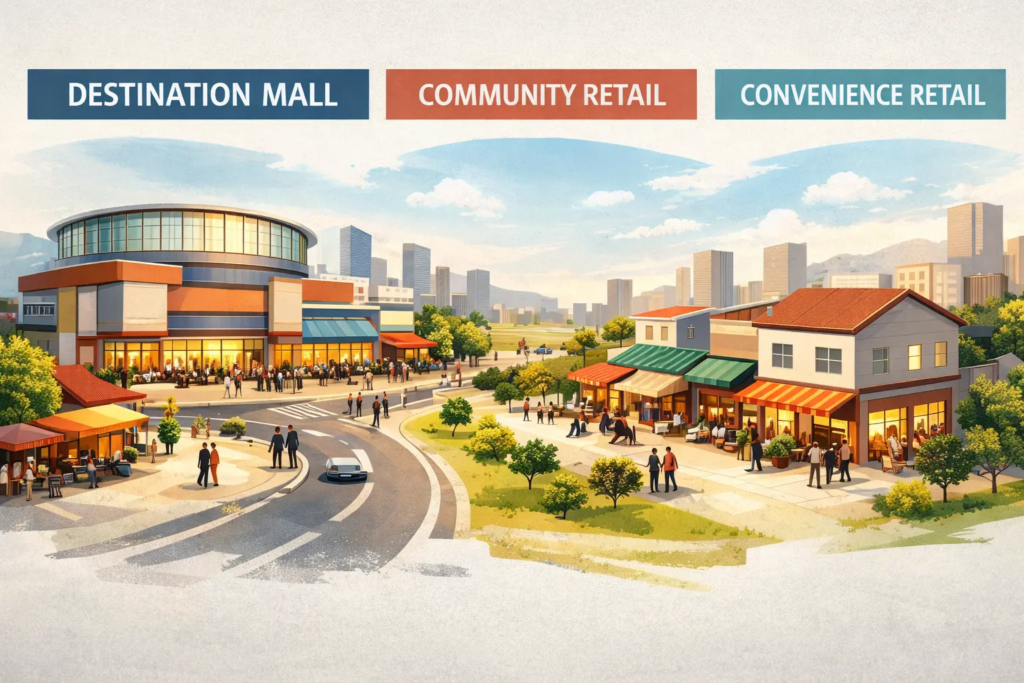
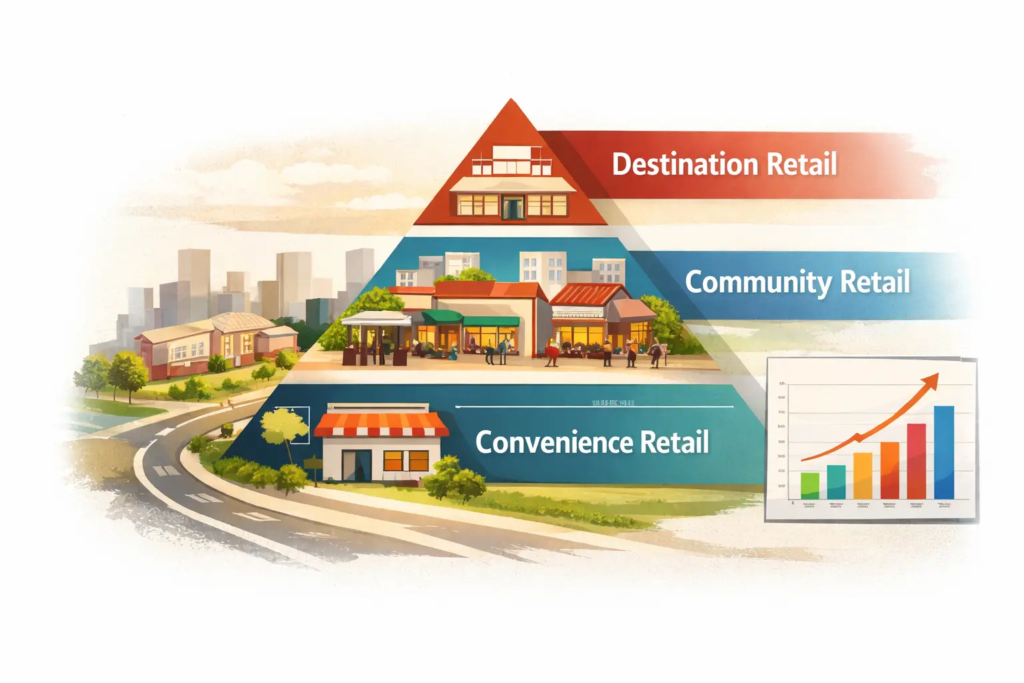
Large mixed-use developments require a clear retail hierarchy to ensure different commercial zones serve distinct roles.
Typical retail hierarchy structures include:
Destination Retail
Large retail assets designed to attract visitors from wider catchments.
Community Retail
Retail clusters that support nearby residential communities.
Convenience Retail
Smaller commercial nodes integrated into neighbourhood environments.
When hierarchy planning is absent, multiple retail areas compete internally rather than supporting each other.
Balancing Retail Supply with Demand
Balancing Retail Supply with Demand
Retail supply must align with long-term market demand.
In emerging cities, developers sometimes introduce excessive retail space during early development phases in anticipation of future population growth.
When retail supply grows faster than demand, projects may experience:
- slow leasing absorption
- vacant units
- reduced commercial momentum
Retail feasibility analysis helps determine sustainable retail supply by evaluating population growth, spending patterns, and competing retail environments.
How Retail Advisory Supports Egyptian Developments
Retail planning decisions made during early project stages often determine long-term commercial performance.
Specialist advisory helps developers evaluate retail demand, structure tenant mix strategy, and define commercial positioning across large-scale developments.
RLPC supports developers through retail feasibility analysis, mixed-use retail strategy advisory, and tenant mix planning. By aligning retail planning with development phasing and infrastructure growth, advisory input helps ensure commercial environments remain sustainable as markets evolve.
Retail Planning for Egypt’s Future Cities
As Egypt continues expanding large-scale developments such as the New Administrative Capital, retail planning will play a critical role in shaping successful mixed-use environments.
Structured retail strategy helps ensure commercial environments support community life while protecting long-term investment performance.
Conclusion
Retail environments within emerging cities require careful strategic planning. When retail hierarchy, demand validation, and tenant mix planning are addressed early in the development process, projects are better positioned to achieve sustainable commercial performance.
Developers working in rapidly growing markets increasingly recognise the value of structured retail strategy in supporting long-term urban and commercial success.
Advisory support from experienced retail consultants such as RLPC helps developers evaluate retail demand, structure tenant mix strategies, and ensure commercial environments remain sustainable as emerging cities continue to evolve.
Frequently Asked Questions
Retail strategy ensures commercial environments align with population growth, infrastructure development, and long-term market demand.
Retail hierarchy planning defines different retail roles within a development, such as destination retail, community retail, and convenience retail.
Retail planning helps improve commercial viability and public space activation within mixed-use environments.
Retail feasibility helps determine sustainable retail supply and reduce the risk of underperforming commercial space.