


AI Is Changing Retail. But Not in the Way Most People Think.
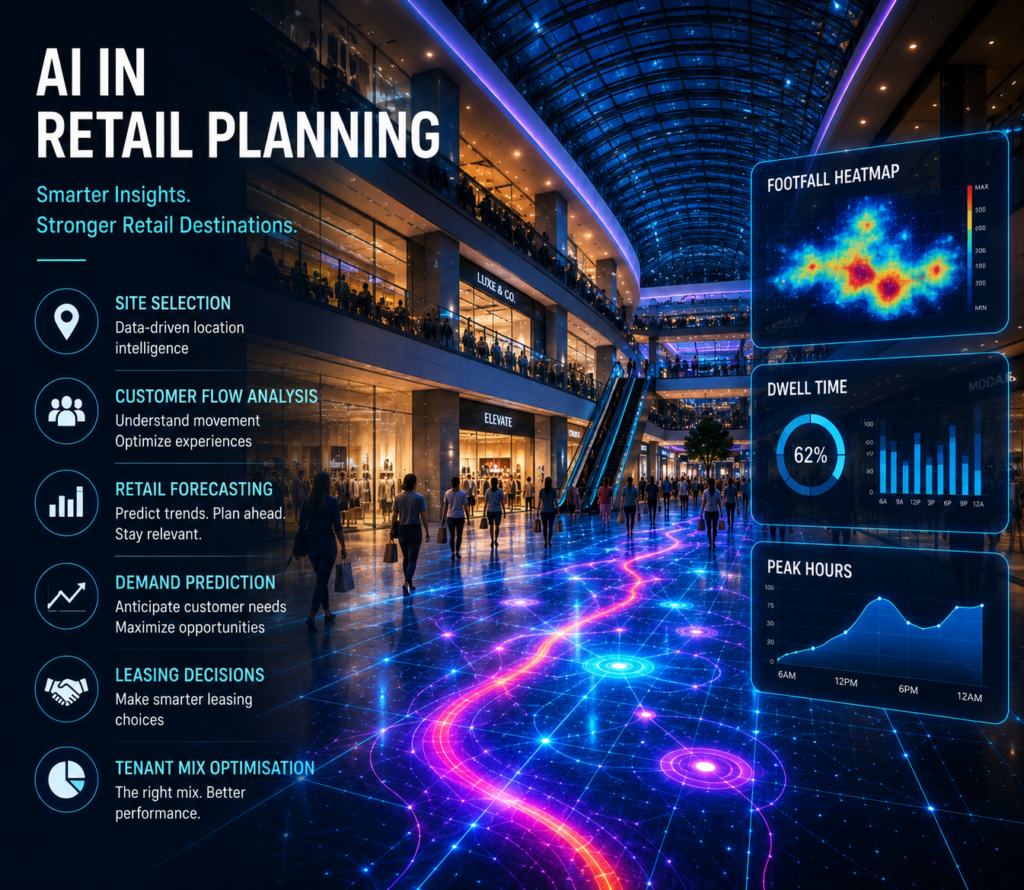
When people hear about Artificial Intelligence (AI), the conversation often revolves around chatbots, content creation, or tools like ChatGPT.
While these technologies are changing how businesses communicate, they represent only a small part of AI’s impact on the retail industry.
The real transformation is happening behind the scenes, where AI is helping developers, retailers, and retail consultants make smarter strategic decisions long before a shopping centre opens its doors.
From selecting the right location to optimising tenant mix and forecasting customer demand, AI is becoming an essential part of modern retail planning.
At RLPC, we see AI not as a replacement for human expertise, but as a powerful tool that enhances data-driven decision-making and creates stronger retail destinations.
AI Is Making Retail Planning More Intelligent
Retail developments generate enormous amounts of data.
Consumer demographics, mobility patterns, spending habits, competitor locations, transportation networks, and economic indicators all influence the success of a retail project.
Traditionally, analysing this information required extensive manual research.
Today, Artificial Intelligence in Retail enables planners to process vast datasets more efficiently, identify hidden patterns, and generate insights that support better business decisions.
The result is faster analysis, improved accuracy, and reduced uncertainty during the planning process.
Smarter Site Selection
Location remains one of the most critical factors in retail success.
AI can analyse multiple variables simultaneously, including:
- Population growth
- Household income
- Accessibility
- Road networks
- Public transport connectivity
- Existing competition
- Consumer mobility
- Future urban development
Instead of relying solely on historical trends, AI helps identify locations with the strongest long-term commercial potential.
For developers, this leads to more informed investment decisions and stronger project viability.
Understanding Customer Flow Through Data
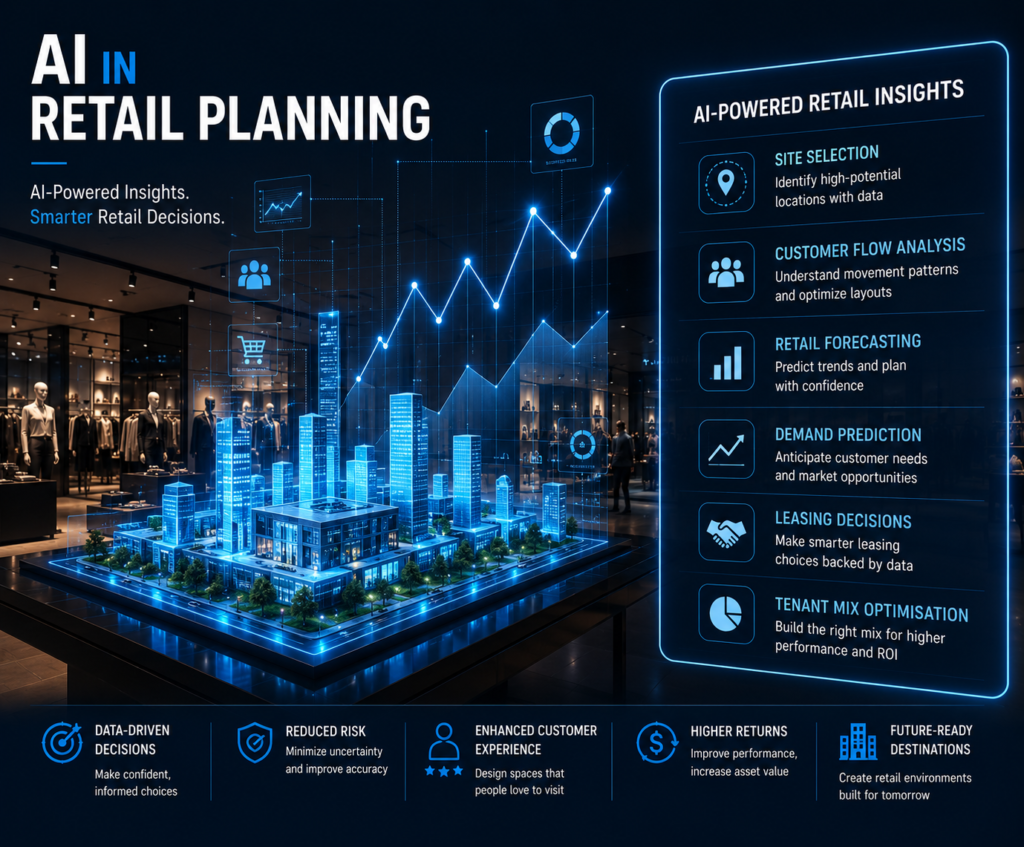
Knowing where people walk, gather, and spend time is essential when designing successful retail environments.
Using mobility data and predictive analytics, AI can help evaluate:
- Footfall patterns
- Peak trading periods
- Customer movement
- Entry and exit points
- High-engagement zones
- Underperforming areas
These insights support better circulation planning, improved layouts, and enhanced customer experiences.
Effective customer flow analysis allows shopping centres to maximise visibility, increase dwell time, and improve tenant performance.
Better Retail Forecasting
One of AI’s greatest strengths is its ability to identify future trends.
Rather than relying solely on historical performance, AI-powered retail forecasting combines multiple data sources to estimate future demand more accurately.
This includes analysing:
- Consumer spending behaviour
- Economic conditions
- Seasonal trends
- Tourism activity
- Population changes
- Local development projects
Developers and investors can use these insights to reduce risk and make better-informed commercial decisions.
Demand Prediction Creates Stronger Retail Destinations
Every successful retail development begins with understanding what consumers actually need.
AI helps improve demand prediction by identifying:
- Categories with growing demand
- Emerging consumer preferences
- Service gaps within catchment areas
- Future retail opportunities
Instead of copying neighbouring developments, planners can create destinations tailored to local market demand.
This leads to stronger differentiation and greater long-term resilience.
Smarter Leasing Decisions
Leasing is no longer simply about filling vacant units.
Successful shopping centres carefully curate their tenant mix to create balanced ecosystems where businesses complement one another.
AI supports leasing teams by helping answer important questions such as:
- Which retail categories are underrepresented?
- Which brands attract target audiences?
- Which adjacencies improve customer journeys?
- Which tenant combinations increase cross-shopping?
- How can vacant spaces create maximum commercial value?
By combining market intelligence with predictive analytics, leasing strategies become more effective and commercially sustainable.
AI Supports Better Tenant Mix Optimisation
A strong tenant mix strategy remains one of the most important drivers of shopping centre performance.
Artificial Intelligence can evaluate multiple factors simultaneously, including:
- Customer demographics
- Spending behaviour
- Retail category performance
- Brand compatibility
- Space utilisation
- Footfall distribution
- Visitor preferences
This enables planners to create retail environments that deliver greater variety, stronger customer engagement, and healthier long-term occupancy.
Importantly, AI provides recommendations, but experienced retail consultants remain essential in interpreting these insights within local market contexts.
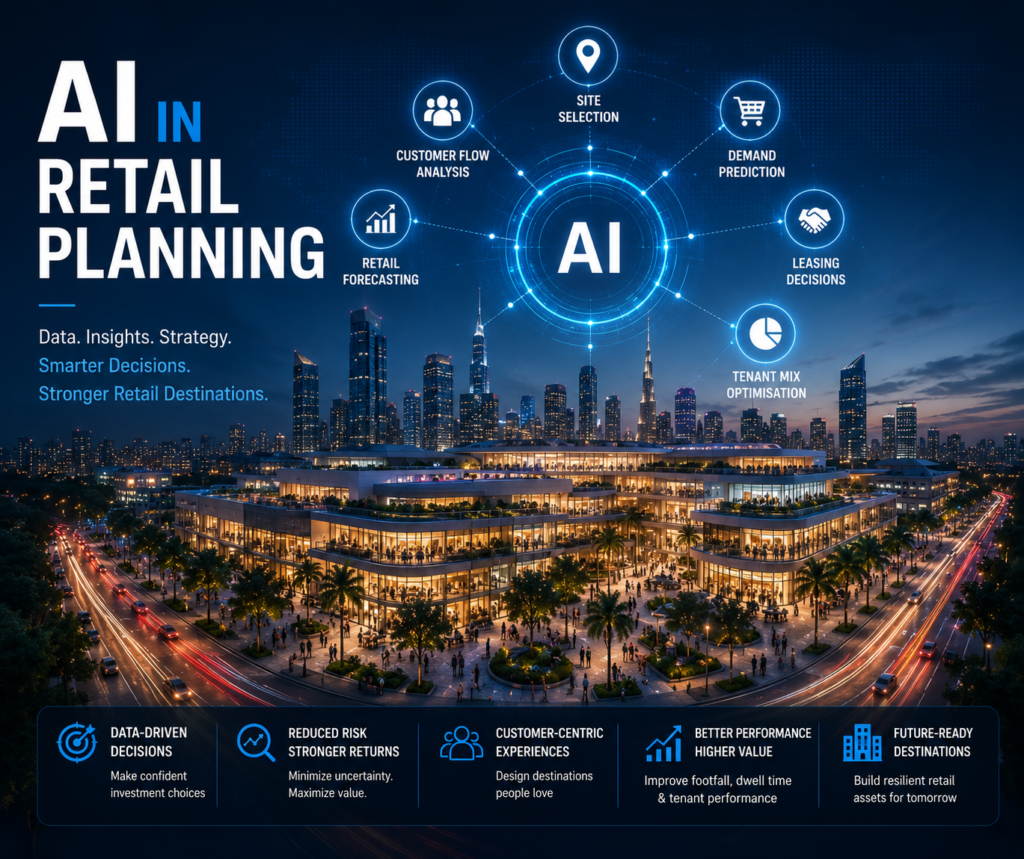
AI Is Enhancing Human Expertise, Not Replacing It
Despite rapid technological advances, successful retail planning still depends on strategic thinking, commercial understanding, and local market knowledge.
Artificial Intelligence can process data quickly.
It cannot replace:
- Human judgement
- Community understanding
- Brand positioning
- Stakeholder collaboration
- Development vision
- Retail experience
The most successful projects combine advanced technology with experienced professionals who understand how to translate data into practical business strategies.
At RLPC, we believe this combination delivers the strongest outcomes.
The Future of Retail Planning Is Data-Driven
Retail continues to evolve alongside changing consumer behaviour.
Developers who embrace data-driven planning will be better positioned to create destinations that remain relevant, resilient, and commercially successful.
Artificial Intelligence is enabling more accurate forecasting, smarter planning, and stronger investment decisions.
However, technology alone is not enough.
The future belongs to organisations that combine AI-powered insights with strategic retail expertise to create destinations that people genuinely want to visit.
How RLPC Helps Clients Plan Smarter Retail Destinations
At RLPC, we combine market intelligence, commercial expertise, and advanced analytical methodologies to help clients make confident retail decisions.
Our services include:
- Retail Strategy
- Retail Master Planning
- Site Selection Analysis
- Catchment & Market Assessment
- Tenant Mix Strategy
- Retail Forecasting
- Leasing Strategy
- Retail Feasibility Studies
- Mixed-Use Development Consultancy
By integrating data-driven insights with practical retail expertise, we help developers, investors, and public sector organisations create retail destinations designed for long-term success.
Frequently Asked Questions
How is AI used in retail planning?
AI helps analyse large datasets to support site selection, customer flow analysis, demand prediction, retail forecasting, leasing strategies, and tenant mix optimisation.
Can AI replace retail consultants?
No. AI provides valuable insights and predictive analysis, but experienced retail consultants are essential for interpreting data, understanding local markets, and making strategic commercial decisions.
What are the benefits of AI in retail development?
AI improves planning accuracy, reduces investment risk, enhances forecasting, supports better tenant selection, and enables more informed decision-making throughout the retail development process.
Why is tenant mix optimisation important?
A well-balanced tenant mix improves customer experience, increases footfall, supports retailer performance, and strengthens the long-term value of a retail destination.