


In many retail developments, increasing footfall is often associated with higher marketing budgets. However, sustained footfall growth rarely depends on promotional activity alone.
In reality, many shopping malls underperform not due to lack of marketing, but because underlying retail planning, tenant mix structure, and customer movement patterns are not aligned with how people interact with physical environments.
Developers are increasingly recognising that improving footfall often requires strategic optimisation of existing retail environments, rather than additional marketing expenditure. RLPC works with developers and asset owners to identify these structural inefficiencies and unlock latent footfall potential within existing developments.
Understanding Why Footfall Stagnates
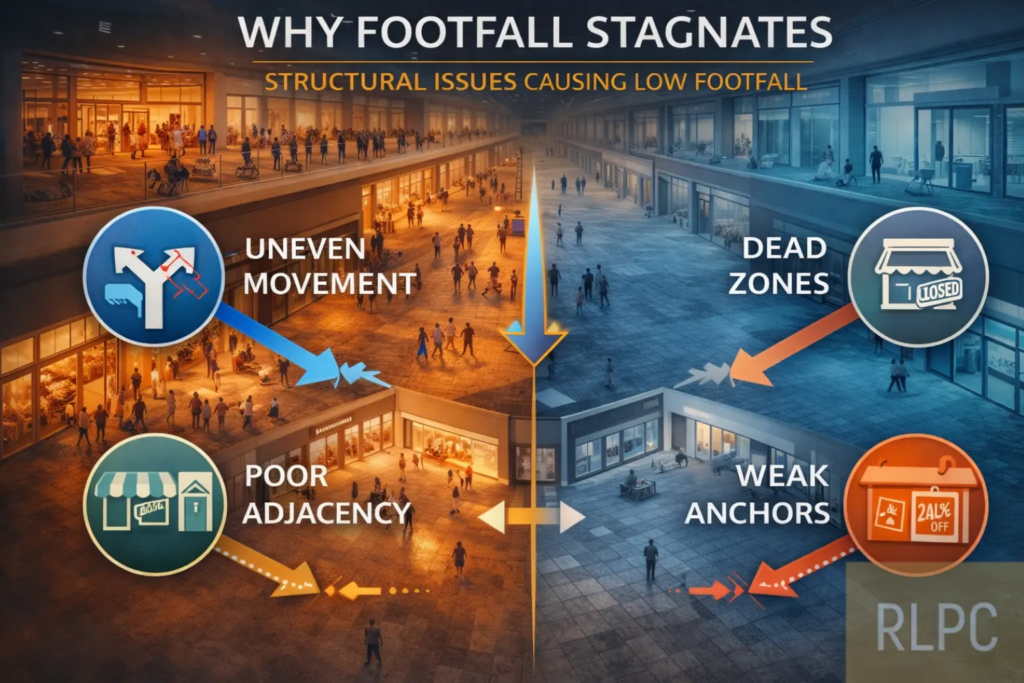
Footfall stagnation is often a structural issue rather than a promotional one.
Common underlying factors include:
- uneven customer movement across the mall
- inactive retail zones
- poor tenant adjacency
- weak anchor positioning
While marketing may temporarily increase visits, these structural gaps often prevent sustained engagement.
Rebalancing Customer Movement Patterns
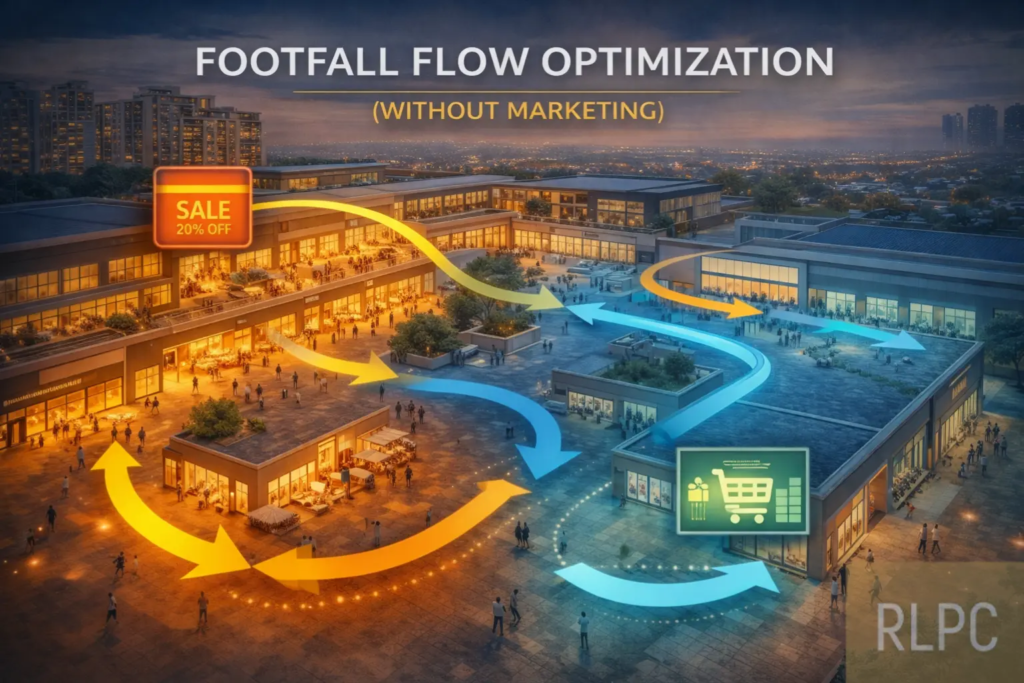
Customer movement within a mall is not random. It is influenced by spatial design, visibility, and tenant positioning.
In many developments, certain areas attract high footfall while others remain underutilised. Strategic circulation optimisation can help redistribute customer flow more effectively across the retail environment. This often involves subtle but high-impact interventions that are not always visible at a surface level.
Strengthening Tenant Adjacency and Mix
Footfall is closely linked to how tenants are grouped within the mall.
When retail categories are poorly structured, customers may visit only specific zones rather than exploring the entire environment.
Effective tenant mix strategies encourage:
- cross-category movement
- longer dwell times
- repeat visits
However, tenant mix optimisation requires a deeper understanding of customer behaviour and retail performance patterns.
Activating Underperforming Zones
Many malls contain zones that receive limited visibility and low customer engagement.
These areas are often the result of:
- poor spatial positioning
- weak retail clustering
- lack of destination anchors
Targeted activation strategies can help reposition these zones within the overall retail ecosystem, improving both visibility and engagement without additional marketing spend.
Aligning Retail with Everyday Behaviour
Successful retail environments are designed around how people naturally move, gather, and spend time.
Developments that integrate retail into daily routines, such as convenience, dining, and social interaction, tend to generate more consistent footfall. This requires aligning retail planning with real-world behavioural patterns rather than purely commercial assumptions.
How Retail Advisory Unlocks Hidden Footfall Potential
Improving footfall without increasing marketing spend requires a structured evaluation of the entire retail environment.
RLPC supports developers through detailed retail performance analysis, circulation assessment, and tenant mix optimisation. By identifying inefficiencies within existing developments, advisory input helps unlock footfall growth that is often overlooked during initial planning stages.
Conclusion
Increasing mall footfall is not solely a function of marketing investment. In many cases, the opportunity lies within the existing retail environment itself.
By optimising circulation, strengthening tenant mix, and activating underperforming zones, developers can significantly improve footfall performance without additional promotional expenditure.
Through structured retail advisory, RLPC helps developers identify hidden inefficiencies within mall environments and implement strategies that support sustainable footfall growth and long-term commercial performance.
frequently asked questions
Yes. In many cases, footfall can be improved by optimising retail layout, tenant mix, and customer movement patterns.
Low footfall is often linked to poor visibility, weak tenant placement, or ineffective circulation planning.
Tenant mix plays a critical role in encouraging customer movement and repeat visits.
Many operational malls benefit from advisory input to identify performance gaps and improve overall retail efficiency.