


Retail development across the Middle East continues to evolve at a rapid pace, driven by large-scale urban expansion, mixed-use developments, and increasing demand for experiential destinations.
However, despite significant investment and ambitious project pipelines, many retail environments struggle to achieve consistent commercial performance.
In most cases, underperformance is not driven by lack of demand but by strategic planning decisions made during early development stages.
Developers are increasingly recognising that long-term success depends on how well retail strategy is aligned with market realities, customer behaviour, and urban infrastructure. RLPC works with developers and master planning teams to identify these gaps early and structure retail environments that remain commercially sustainable over time.
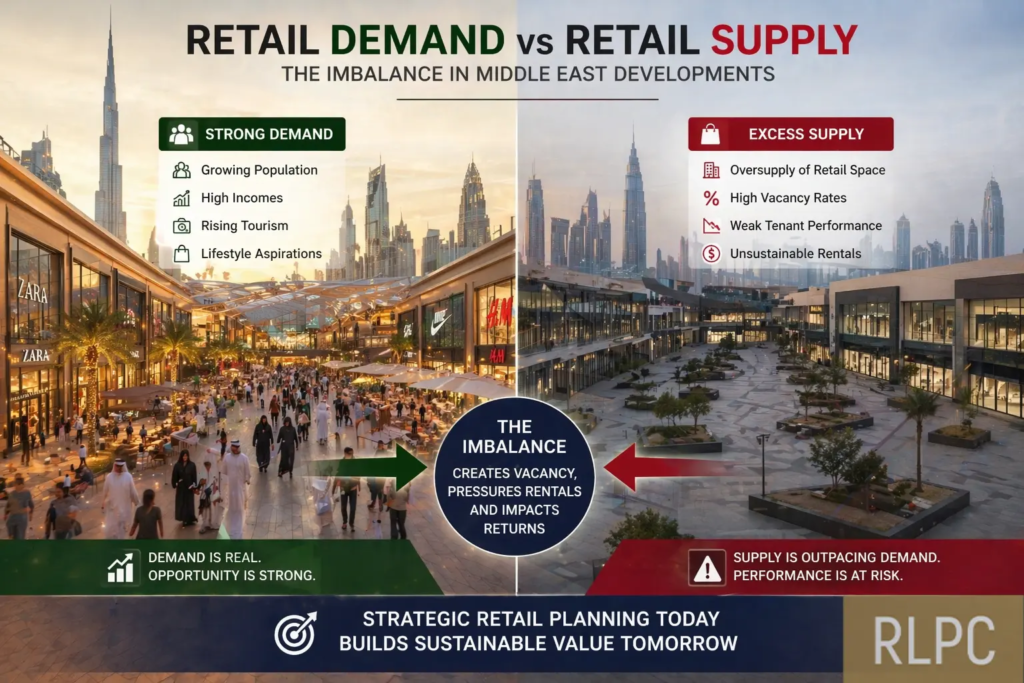
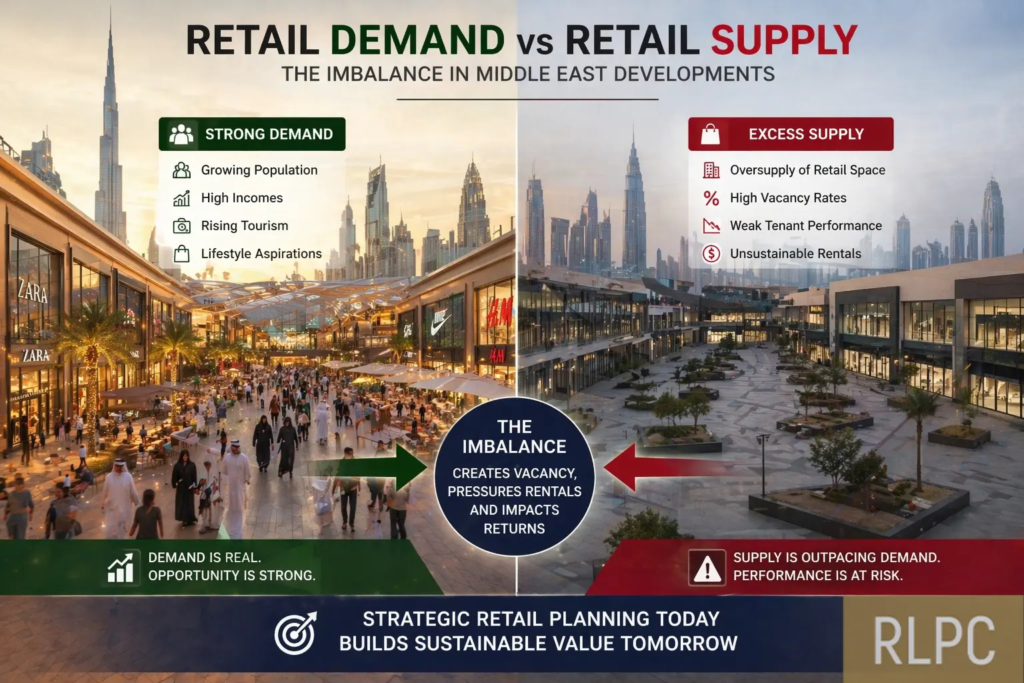
Overestimating Retail Demand
One of the most common challenges across Middle East developments is the assumption that population growth will directly translate into retail demand.
While cities continue to expand, retail supply often grows ahead of actual consumption capacity. This imbalance leads to:
- excess retail inventory
- slow leasing absorption
- declining tenant performance
Without structured demand validation, projects risk entering the market with unsustainable retail scale.
Lack of Clear Retail Positioning
Retail environments that attempt to cater to multiple segments without a defined positioning often struggle to establish a strong identity.
This results in:
- fragmented customer experience
- inconsistent brand perception
- weak destination appeal
Successful developments are typically built around a clear and differentiated retail positioning, allowing them to attract and retain a defined target audience.
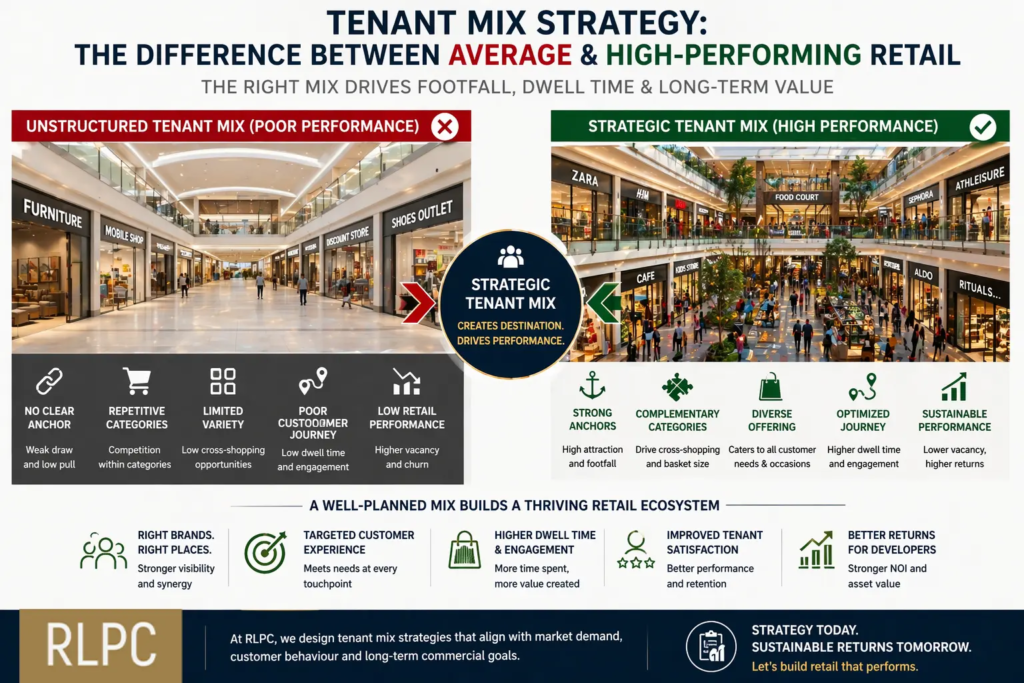
Poor Tenant Mix Structuring
Tenant mix is often treated as a leasing exercise rather than a strategic framework.
When retail categories are not carefully structured:
- customer journeys become disjointed
- cross-shopping opportunities are reduced
- dwell time declines
A well-structured tenant mix ensures that different categories work together to create a cohesive retail environment.
Ineffective Circulation and Visibility
Customer movement within retail environments is rarely random. It is influenced by layout, visibility, and spatial design.
Poor circulation planning can result in:
- underperforming zones
- uneven footfall distribution
- reduced tenant visibility
These issues are often embedded in the design phase and become difficult to correct once the project is operational.
Retail Delivered Ahead of Market Maturity
In several developments, retail components are introduced before surrounding catchment populations have reached sufficient scale.
This misalignment leads to:
- low initial footfall
- weak tenant performance
- delayed commercial stabilisation
Phased retail delivery is critical to ensure that supply aligns with actual market readiness.
Overreliance on Marketing to Drive Performance
In underperforming developments, marketing is often used as the primary tool to increase footfall.
While marketing can generate short-term spikes in traffic, it does not address underlying structural inefficiencies such as:
- weak tenant mix
- poor layout planning
- lack of destination anchors
Sustainable performance is driven by strategy, not promotion.
Lack of Integration with Urban Infrastructure
Retail environments that operate in isolation from surrounding infrastructure often struggle to generate consistent engagement.
Key disconnects include the following:
- limited accessibility
- weak pedestrian integration
- poor alignment with surrounding land uses
In contrast, successful developments are integrated within broader urban ecosystems, allowing retail to benefit from natural movement patterns.
How Retail Advisory Prevents These Mistakes
Most of these challenges originate from early-stage decisions around:
- retail scale
- positioning
- tenant mix
- phasing strategy
Without structured analysis, these decisions are often based on assumptions rather than validated insights.
RLPC supports developers through retail advisory that evaluates market demand, aligns commercial strategy with urban growth, and ensures that retail environments are positioned for long-term performance.
Conclusion
Retail development in the Middle East presents significant opportunity but also requires careful strategic planning.
Projects that align demand validation, tenant mix structuring, and circulation planning from the outset are better positioned to achieve sustainable commercial outcomes.
Through structured retail advisory, RLPC helps developers identify critical planning gaps and implement strategies that support long-term retail performance across large-scale developments in the Middle East.
Frequently Asked Questions
Common mistakes include overestimating demand, weak tenant mix planning, poor circulation design, and lack of clear retail positioning.
Under-performance is often linked to early-stage planning gaps rather than lack of demand, including oversupply and ineffective layout strategies.
Tenant mix plays a key role in shaping customer movement, dwell time, and overall retail performance.
Marketing may drive short-term traffic, but long-term performance depends on retail strategy and structural planning.
Circulation planning influences customer movement, visibility, and how evenly footfall is distributed across retail zones.