


Across emerging retail markets in the Middle East, South Asia, and Africa, Tier 2 cities are increasingly attracting retail investment.
Developers see:
- rising population growth
- urban expansion
- increasing disposable income
- limited organized retail supply
On paper, the opportunity appears strong.
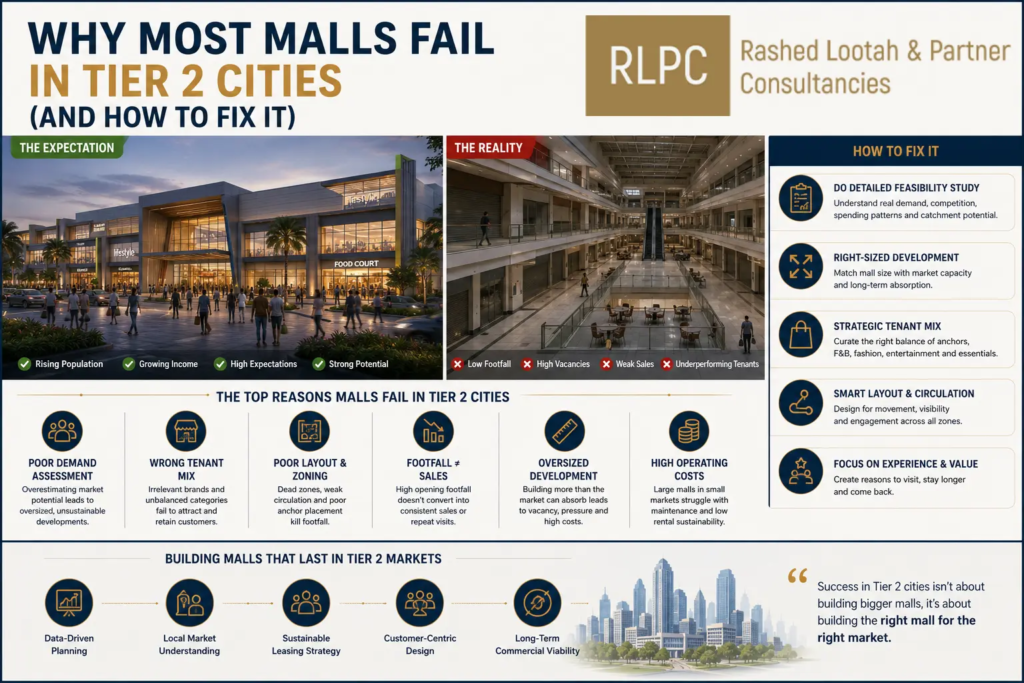
Yet many malls in Tier 2 cities struggle within a few years of opening.
Vacancy increases.
Footfall weakens.
Tenant performance declines.
The problem is rarely the city itself.
In most cases, mall underperformance is driven by planning decisions that fail to align retail strategy with actual market behaviour.
RLPC works with investors and developers to evaluate retail demand, structure commercial positioning, and reduce long-term performance risk in emerging retail markets.
Why Tier 2 Cities Attract Retail Investment
Tier 2 cities often present strong long-term retail potential because they typically experience:
- rapid urbanisation
- growing middle-income populations
- expanding infrastructure investment
- limited competition from established retail assets
This creates optimism among developers seeking an early-mover advantage.
However, retail demand in Tier 2 cities behaves very differently from mature metropolitan markets.
The Biggest Mistake: Assuming Demand Equals Sustainability
One of the most common mistakes developers make is assuming that population growth automatically guarantees mall success.
But population alone does not create sustainable retail demand.
Successful malls require:
- spending capacity
- repeat visitation behaviour
- retail culture maturity
- appropriate retail scale
Many underperforming malls are oversized relative to actual commercial absorption capacity.
This creates long-term leasing pressure and operational inefficiencies.
Poor Tenant Mix Is a Major Failure Driver
In many Tier 2 developments, leasing strategies focus on filling space quickly rather than structuring sustainable retail ecosystems.
This often results in:
- repetitive retail categories
- weak anchor strategy
- poor brand positioning
- limited entertainment value
Without balanced tenant mix planning, malls struggle to create reasons for repeat visitation.
Retail categories must align with local behavioural patterns rather than simply replicating metropolitan mall formats.
Why Footfall Alone Does Not Guarantee Success
Some malls generate initial curiosity-driven footfall after launch.
However, temporary footfall does not necessarily translate into:
- sustainable sales
- tenant retention
- long-term leasing performance
Developers often overestimate the long-term impact of marketing campaigns while underestimating the importance of layout planning, zoning, and customer experience strategy.
Commercially productive footfall is more important than visitor volume alone.
Dead Zones and Circulation Problems
Many Tier 2 malls suffer from:
- isolated corridors
- weak upper-floor activation
- disconnected F&B zones
- poor anchor placement
These structural issues create dead zones that weaken tenant visibility and reduce engagement.
Once circulation problems are embedded into the asset, correcting them becomes operationally expensive.
Retail zoning strategy should be integrated during the early planning phase, not after performance declines.
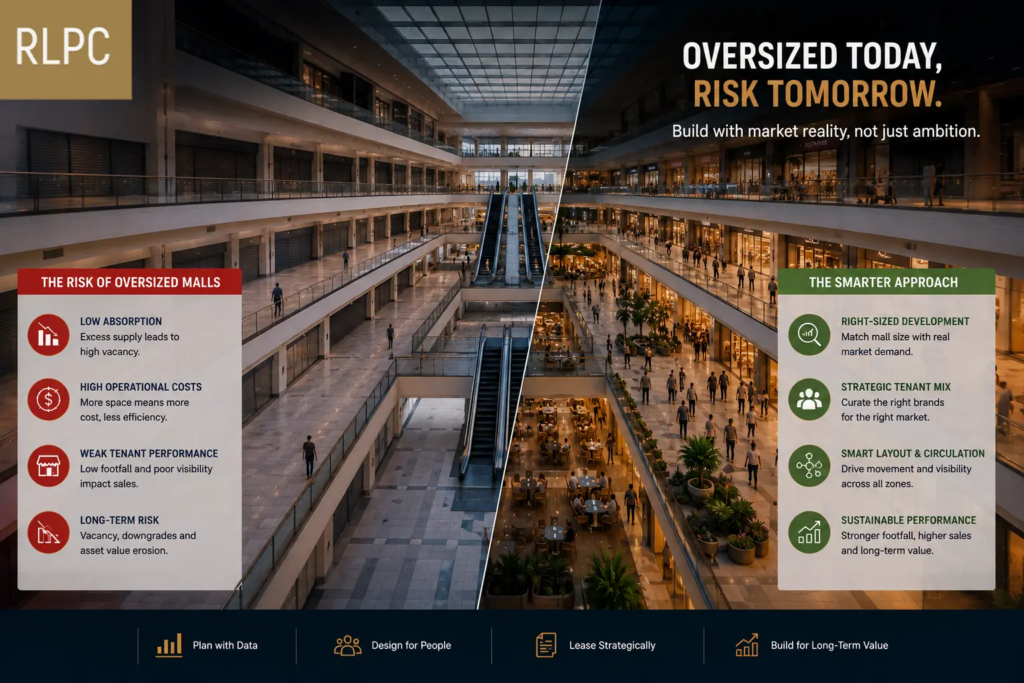
How Oversized Malls Create Long-Term Risk
Developers sometimes attempt to replicate large metropolitan retail formats in smaller markets.
This creates:
- excessive leasable area
- high operational costs
- vacancy pressure
- reduced rental sustainability
In many Tier 2 cities, compact and strategically curated retail environments often outperform oversized developments.
Scale should align with realistic market absorption, not ambition alone.
The Role of Feasibility Studies in Tier 2 Retail Planning
Retail feasibility studies help developers evaluate:
- market demand
- spending patterns
- competitive supply
- appropriate mall sizing
- tenant category demand
Without structured feasibility analysis, developers risk building assets that exceed the market’s actual retail maturity.
Feasibility is not simply a validation process; it is a risk management tool.
How RLPC Supports Retail Success in Emerging Markets
Retail success in Tier 2 cities requires more than construction and leasing.
RLPC supports developers through:
- retail feasibility analysis
- zoning and circulation strategy
- tenant mix structuring
- mall positioning advisory
- commercial sustainability planning
By aligning retail planning with local market behaviour, RLPC helps developers reduce long-term risk and improve commercial resilience.
Conclusion
Tier 2 cities continue to offer significant retail opportunities.
However, long-term success depends on understanding the difference between visible demand and sustainable commercial performance.
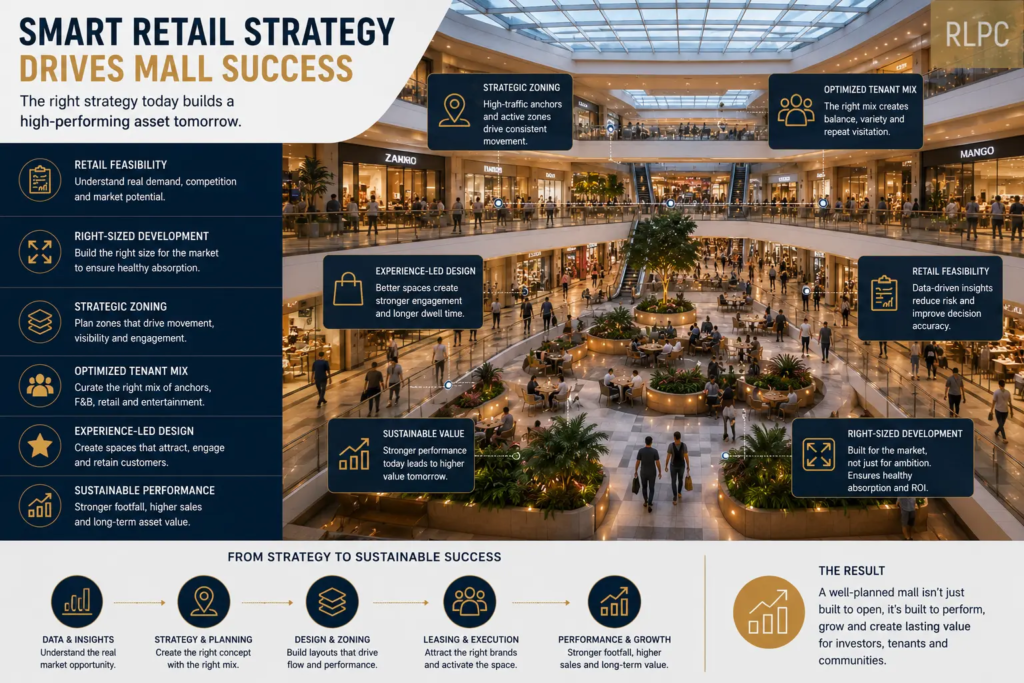
Developers who structure malls around realistic demand, strategic zoning, and balanced tenant mix are better positioned to create high-performing retail assets that remain commercially viable over time.
Through retail feasibility and strategic planning advisory, RLPC helps developers align mall concepts with real market demand, customer behaviour, and long-term commercial sustainability.
Frequently Asked Questions
Most malls fail due to poor feasibility analysis, oversized retail formats, weak tenant mix, and circulation planning issues.
No. Sustainable tenant sales and repeat visitation are more important than temporary visitor volume.
Tenant mix must align with local customer behaviour and spending patterns to create repeat engagement.
Dead zones are low-traffic retail areas caused by poor layout planning and weak circulation flow.
No. Mall size should align with actual retail absorption capacity and spending behaviour.
Through feasibility studies, strategic zoning, optimized tenant mix, and circulation planning.